

Emiliano Terán Mantovani
More than just a regulatory change, the January 29, 2026, reform of Hugo Chávez’s landmark 2001 Hydrocarbons Law—which had already been amended in 2006 to strengthen state control and participation in the industry and its profits—signals a profound economic and political transformation of the century-old Venezuelan petro-state model itself. The country and its sovereignty stand at a crossroads, facing an oil model that has been exhausted for decades but is simultaneously being dismantled amid a deep and prolonged internal political crisis and U.S. intervention that has taken root in Venezuela since January 3, 2026.
This article aims to briefly address this legal reform—hereafter RLH—not only by examining regulatory changes but also by highlighting other dimensions at stake, such as political, environmental, economic, and humanitarian factors. I present a brief background before examining the main amendments made to the law and conclude by analyzing four of the most significant implications and meanings of this process.
I. BACKGROUND
Two factors must be examined to understand the context in which the RLH is situated.
I.I First factor: the new oil opening under Chavismo in previous years
Certainly, the reform—which was swiftly approved and published in Official Gazette No. 6,978[1]—occurred in the context of U.S. military intervention, but it cannot in any way be interpreted as a break with previous energy nationalism.
On the contrary, the Maduro government, at least since 2018, had initiated a strong, albeit unorthodox, process of neoliberalization of the economy, which included the oil industry. As early as 2016, a ‘special investment regime’ that sought to provide greater facilities and incentives to foreign investors was promoted. Equally noteworthy is the 2018 decree exempting transnational capital from the emblematic income tax on profits derived from oil activities. These policies intensified under the Economic Recovery and Prosperity Program (2018), the significant “Anti-Blockade Law” (2020), and the Special Economic Zones Law (2022), alongside other economic liberalization measures.
Faced with the disastrous results of the rigid controls imposed on the entire economy; the urgent need to boost revenues in an industry that was increasingly in decline; and the impact of international sanctions—particularly those imposed in 2019 that directly affected the oil sector— the government promoted a more open and pragmatic shift, not only inviting all companies to invest in Venezuela—especially U.S. investors[2]—but also seeking to ensure that the conditions for such investment were as favorable as possible. In this context, the Hydrocarbons Law had been in the crosshairs of various groups for several years, as it posed regulatory obstacles to these changes—which were to include a proposed constitutional reform that Maduro had incompletely outlined in February 2025[3].
In reality, the submissive approach to oil only intensified, as symbolically evidenced by the “Productive Participation Contracts” (CPP) under the Anti-Blockade Law —which granted enormous powers to private minority shareholders in Joint Ventures — and above all, by OFAC’s LG41 License (November 2022), which allowed Chevron to resume its activities in Venezuela. This license has been classified as a “business model”[4] that reflected the pattern of extraordinary concessions and privileges granted to corporations that began to prevail in the country from that point onward. LG41 authorized the U.S. corporation to directly manage primary operations and administer the mixed enterprises, including the production and marketing of extracted oil. It also prohibited the corporation from paying royalties and taxes to the State, and it barred Iranian and Russian companies from serving as suppliers to the mixed enterprises. This not only violated the Hydrocarbons Law of the time and the Constitution, but also established clear forms of interference in the country’s sovereignty.
This license, as well as the commercial arrangements that de facto existed with China in the Orinoco Oil Belt—where a large portion of the crude oil and profits are retained by the Chinese (due to significant shipments for debt repayment, discounts, and intermediary costs) and they held logistical and operational control over the exploitation[5]—reveal that the historic concept of energy nationalism was already being dismantled. As we will see in the following section, the provisions of LG41 would ultimately be confirmed and enshrined in the RLH; thus in this sense, elements of continuity are evident between the Maduro administrations and the government led by Delcy Rodríguez. If one were to speak of a capitulation of Venezuela’s energy sovereignty, it began before the invasion and the reform of the law.
Maduro did not deny the U.S. access to oil; on the contrary, he offered concessions. Rather, it was U.S. sanctions that were the main factor disrupting this south-to-north energy flow. But the one point on which Maduro was unwilling to negotiate was his departure from power. These elements of continuity must be highlighted as another factor at play in the persistence of the post-January 3 Chavista regime.
I.II Second factor: authoritarianism and total disregard for the law
The deterioration of democracy in Venezuela accelerated at least since 2017, with the creation of the “plenipotentiary” National Constituent Assembly. Many steps were gradually taken toward the consolidation of an authoritarian regime[6], which likely reached its peak with the electoral fraud of July 28, 2024, and the unprecedented intensification of social repression, as well as the establishment of state terrorism[7]. Within this framework, the Republic’s fundamental laws and the national Constitution itself became a dead letter, and the institutions that in theory oversee and guarantee their enforceability were significantly undermined. In contrast, other laws, such as the 2020 Anti-Blockade Law, were established as exceptions that consolidated the Chavista government’s discretion in managing state assets and in establishing agreements with foreign corporations, as well as the secrecy and opacity of its operations.
Within this logic, oil operations and agreements were adjusted and shaped to accommodate the circumstances of PDVSA’s inoperability and the effects of international sanctions, as well as the particular interests of the government and companies, regardless of the constraints imposed by existing laws. The aforementioned LG41 License granted to Chevron was based on direct negotiations between the U.S. and the Maduro government and was formalized without the approval of the National Assembly. The arrangements made with China in the Orinoco Belt followed similar criteria of discretion and secrecy.
The Maduro government exercised its power through a neo-patrimonial style of governance, running the country as if it were a personal estate. The validity and actual applicability of laws and regulatory bodies in Venezuela must be understood within this framework.
So, what is the point of the RLH in this context?
Domestically, the reform takes shape within a political environment that, following the January 3 events, remains authoritarian. The RLH in fact violates the Constitution—which must take precedence over all other laws—in articles such as Article 302, which reserves oil activities for the State; Article 307, given the discretionary delegation of royalties and taxes; Article 150, by dispensing with parliamentary approval for the conclusion of contracts of public interest; or Article 151, by providing for the resolution of disputes in international forums as well; to mention a few examples. These elements demonstrate the regulatory nullity of said reform due to its unconstitutionality.
This also unfolds within the tutelary power exercised by the Trump administration over the entire management of the Venezuelan oil industry, which completely undermines not only the country’s legal framework but also the very concrete structure of the Republic and its institutions.
Thus, the main rationales behind the RLH are twofold: first, to establish a framework of guarantees, legal stability, and certainty for the massive influx of transnational capital into the industry; and second, to consolidate a legal framework that makes sense for a potential new subordinate political regime, one that would further embed and consolidate these changes for the coming decades in the country.
II. THE JANUARY 2026 REFORM OF THE HYDROCARBON LAW: 8 KEY POINTS
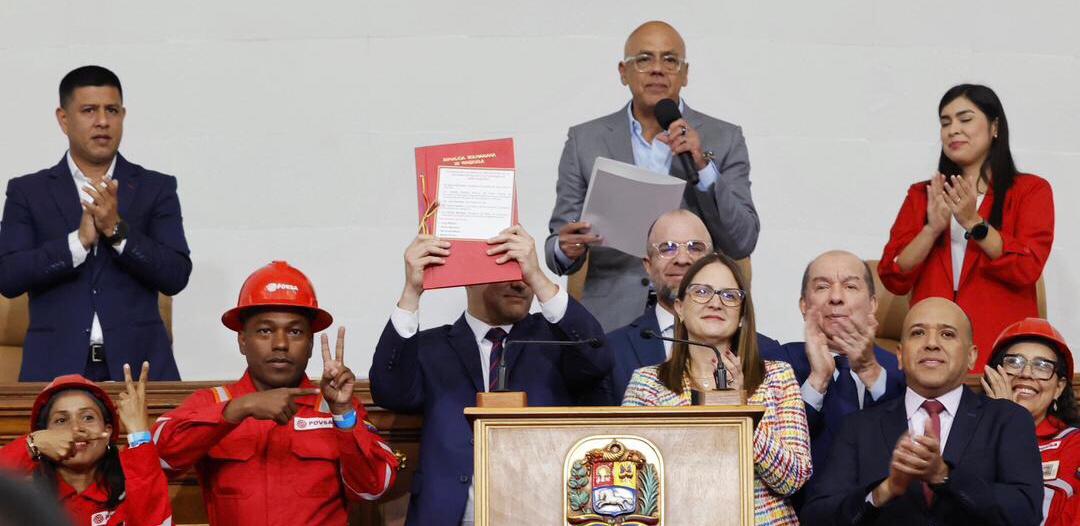 Just 26 days after the ousting of Maduro and Cilia Flores, the RLH was enacted. It was said that it was informed by “consultations across the country,” “from more than 120 proposals received,” and that it was approved unanimously, “in the name of God,” while the entire so-called “Bancada de la Patria” stood to applaud this official adoption[8]. Given that this has represented a historic event for Venezuela, it will always be appropriate to remember the legislators (both Chavistas and opposition members) and ministers who put their names to this reform.
The RLH has completed the formal dismantling of the “Bolivarian project,” which among its pillars had championed an energy nationalism opposed to the neoliberal and denationalizing model of the “Oil Opening,” and which envisioned the restoration of the Petro-state, this time to build an alternative to capitalism: “21st-Century Socialism.” What is striking is that this dismantling has been carried out progressively from within and for years, as part of a transformation of Chavismo[9] that was also fueled by international sanctions. Today, this transformation appears largely subordinated following U.S. intervention, with U.S. military and corporate power shaping the new law.
What does this reform specifically entail?
What scenarios does it open up for us? I list 8 key points below:
- The first thing to note is that, although the reform is classified as “partial,” it should be emphasized that it has in fact been substantial, altering the law’s previously statist and predominantly state-centered character to make way for extensive private participation and authority. Several articles were expanded, and new sections were added.
- It is key to note that Article 23 has eliminated total or majority state exclusivity in the sector’s primary activities. Private companies are recognized as one of the three types of actors that may participate in these activities, alongside national entities and mixed enterprises.
- It is true that, in nominal and regulatory terms, it is emphasized that ownership of the oil fields remains with the Republic (Article 40, and in Article 3, which was retained from the LH-2006). However, the Venezuelan side has been severely affected, undermined, and stripped of its capacity to exercise effective and genuine sovereignty and act as the owner of the oil and the exploitation activities, a fact that had already become evident with the establishment of the CPPs. In fact, the THIRD Transitory Provision underscores the continued “full legal validity and effectiveness” of the CPPs and other contractual models entered into pursuant to the Constitutional Anti-Blockade Law.
- In line with the previous point, the RLH establishes the possibility of partial or total transfer of the rights granted from national companies to private companies (Article 25). Article 40, which was incorporated as a new article, provides that contracts may be entered into with private companies for the performance of primary activities, in which such companies may assume the “comprehensive management” of the performance of the activities; that is, all operations. Article 36 (new), Paragraph 3, provides that the Ministry with jurisdiction over hydrocarbons may authorize the private minority shareholder to exercise technical and operational management of the joint venture. Article 42 (new) provides that companies of the Republic and their subsidiaries may transfer to the operating company the right to use the operational area and the delineated area. All of this is highly significant, not only because of the extraordinary expansion of private companies’ powers, but also because of the considerable reduction in the role and influence of Petróleos de Venezuela S.A., all the more so in this context of institutional and national vulnerability.
- It does not end there: Article 41 (new) provides that operating companies may be compensated with a percentage share of the volumes of hydrocarbons under supervision, which would be marketed directly by the operating company. Article 68 provides that the competent Ministry may authorize private companies to directly market all or a portion of the volumes of natural hydrocarbons produced in the assigned area. Article 36, Paragraph 1 also authorizes the private minority shareholder to market all or part of the Joint Venture’s production. And under Article 42 (new), upon receiving the rights to use the operational area, the operating company may pay with oil as consideration to companies of the Republic. In turn, Article 36, Paragraph 2 authorizes said private shareholder to open and manage bank accounts in any currency and jurisdiction for the use and administration of the funds. All of this reveals that the powers granted to private entities are much broader, thus including the direct management and marketing of the resource, as well as autonomy in managing their finances.
- Another significant element relates to the possibility of reducing royalties and taxes collected from the activity. While the previous law set the royalty at 30%, in the RLH this percentage is determined by the competent Ministry based on the type of project, capital investment requirements, the project’s “economic viability,” and international competitiveness (Article 51). Although the previous law recognized the possibility that, for economic reasons in mature fields or in the Orinoco Belt, the royalty could be reduced to 20%, in the current RLH that figure remains open and at the discretion of the ministry. Article 58 (new) proposes this same flexibility and criteria for reducing the Income Tax, which was set at 50% prior to the reform. Article 26 establishes that, if legal, fiscal, regulatory, or contractual changes occurring after the execution of contracts negatively affect the ‘project economics,’ the Ministry may make adjustments to royalties, taxes, tariffs, terms, economic conditions, or compensation mechanisms to ‘restore the prior economic position’ of the operating company. It is important to note that, in practical terms, the “economic viability” referred to is linked not only to the viability of a given project but also to the profit margin requirements that private companies consider ideal. Additionally, Article 55 eliminates the various taxes stipulated in the previous law (surface, extraction, consumption, and export registration taxes, formerly Article 48) and creates the “Integrated Hydrocarbons Tax,” simplifying the tax burden. The rate of this tax may not exceed 15% and is determined by the competent Ministry (Article 56). And Article 59 exempts companies from a list of other taxes and contributions—such as the Wealth Tax or social contributions.
- Finally, Article 34 eliminates the requirement for approval by the National Assembly for the establishment of mixed enterprises and the conditions governing the conduct of primary activities. Now this must only be ‘notified’; decisions and authorizations are primarily handled by the Executive. On the other hand, in Article 8 (new), in the event of doubts and disputes, alternative dispute resolution mechanisms are also provided for, including mediation and arbitration, which may be international.
- It is recalled that the following were repealed: the Law on the Regularization of Private Participation in Primary Activities Provided for in Decree No. 1,510 with the Force of Law (2006); the Organic Law reserving for the State Goods and Services Related to Primary Hydrocarbon Activities (2009); the Law establishing the Special Contribution for Extraordinary and Exorbitant Prices in the (2013); or Decree No. 5,200, Law on the Transition to Joint Ventures of the Association Agreements for the Orinoco Oil Belt and Exploration Agreements on a Risk and Profit-Sharing Basis (2007); among others.
III. TRENDS, MEANINGS AND IMPLICATIONS OF THE TRANSFORMATIONS OF THE OIL REGIME
Given that these still-ongoing transformations are disrupting the very structure of the historic oil model, there are numerous implications to examine. For this article, I will specifically highlight four of them: the emergence of a vassal petro-state; the formation of an enclave economy and the perpetuation of oil extractivism; the economic decline sustaining the state and its consequences for society; and the dangerous invisibilization of the ecological/climate crisis.
III.I The Emergence of a Vassal Petro-State
What is the Venezuelan state today, if it has ceased to be that petro-state that once achieved a high degree of centralization of power and the economy, a considerable level of rent-seeking, and relative international influence—from the creation of OPEC in the 1960s to Chávez’s proposals for regional integration?
As might be expected, oil will remain an important resource for Venezuela. As long as reserves of such magnitude exist, alongside the great weakness of other economic sectors and a global context of war over resources and energy, it is likely that we will continue to have a petro-state that bases the majority of its revenue on crude oil. What is changing is the new form of vassalage it is acquiring.
How long could this regime of subjugation last?
Within the logic of the so-called ‘Donroe Doctrine,’ the U.S. government will seek to maintain maximum subjugation of the Venezuelan state, all the more so if its geopolitical objectives on other continents remain unfulfilled. On the other hand, if the Chavista regime manages to adapt to this formula and offers the U.S. an advantageous relationship, this could allow the regime to persist over time.
To break free from this vassalage, Venezuela would need, on the one hand, to achieve sufficient unity among national/nationalist forces capable of opposing U.S. power; on the other hand, to recover, as much as possible, its institutional, economic, and military capabilities, thereby maintaining a minimal degree of sovereignty. However, such a recovery does not seem feasible in the short term, as fragmentation has prevailed, including within Chavista forces. In any case, these scenarios are not without contradictions, whether due to Trump’s declining popularity in the U.S. or potential internal fractures in Venezuela, with uprisings or confrontations that could generate complex national conflicts.
This entire framework has posed a historic challenge to the notions of sovereignty that have been built in the country over decades, if not centuries. This challenge also concerns Latin America and the Caribbean, which view what has occurred in Venezuela as a process of aggressive re-colonization with regional implications. What is this thing we call sovereignty today?
III.II Enclave Economy and the Perpetuation of Oil Extractivism
The destruction of Venezuela’s traditional oil economy model—amid the evolution of Chavista oil liberalization, the RLH, and the already established U.S. subjugation—which controls the entire chain of operations, commercialization, and administration of the national hydrocarbon industry—is leading us toward the formation of a kind of enclave economy.
Enclave economies were studied by dependency theory to describe a “development model” that emerged in several Latin American countries between the last quarter of the 19th century and the first quarter of the 20th, referring to resource extraction activities that became disconnected from the broader national economy, as they were directly controlled from abroad[10]. This entailed organizing territories as mere suppliers of resources (or labor) for the global market, with extractive activities that had little connection to local populations and revenues that were transferred outside the jurisdiction.
As we can see, this once again refers to patterns from a distant past. The Venezuela we have known over the last hundred years may end up becoming blurred and fragmented, now marked by the proliferation of territories of plunder with high levels of disconnection from the national economy. As if the country were defined fundamentally by being a collection of oil fields and mines.
This also perpetuates, for the umpteenth time, oil extractivism in Venezuela, seriously blocking any possibility of steering the country down a different path, given a history of dependency, rent-seeking, corruption, and massive environmental damage that is inextricably linked to this societal model. The prevailing national discourse following January 3 reflects the usual trends, which view this as an “opportunity” to boost oil and gas production once again. This has been stated, for example, by former Chavista oil minister Rafael Ramírez[11]1 and former opposition energy minister Humberto Calderón Berti[12], and is presented as a consensus by the vast majority of economists[13]; Delcy Rodríguez stated that Venezuela must become “a true oil and gas producing power”[14], and María Corina Machado proposed at CERAWEEK 2026 a national target of five million barrels per day[15]. Some minority voices, however, have denounced the surrender of oil sovereignty[16]; while the discussion on ‘energy transition’ is negligible. But what stands out is a significant lack of questioning of the very model that has proven unsustainable both nationally and globally. These historical gaps in the discussion are once again evident, alongside the extremely adverse conditions for considering post-3-E alternatives.
However, it is important to highlight some contradictions in this outlook for oil expansion that has been predicted by many. The damage suffered by the industry and the rehabilitation of numerous abandoned wells require enormous investments, estimated at between US$100 billion and US$180 billion, to return to an estimated production of approximately 2.5 million barrels per day over the next 10–15 years[17]—if all goes well. On the other hand, the vast majority of the reserves to be developed are heavy and extra-heavy crudes with high production costs—which require high prices to sustain the investments—while conventional crudes are typically in decline phases with costs that have also increased. While production can be increased from fields such as Boscán (conventional) in Lake Maracaibo and from existing capacity in the Orinoco Belt, in other cases it is more complicated and costly—such as starting operations from scratch in the Belt—and few investors are likely to be truly attracted.
III.III A petro-state without revenue or assets: how is the country we have known sustained?
With the structure for capturing royalties and taxes shattered, and the state’s own capacity to manage public assets through PDVSA undermined, the very sustainability of the state’s operational capabilities is now in jeopardy. One should recall that Venezuela still depends on oil revenues for 80–90% of its income and, as I have mentioned, the rest of the economic sectors are far from being able to provide a similar source of revenue for the state coffers. How, then, can a model of society that was shaped for decades around oil revenues recover and sustain itself?
These changes will have a fourfold impact on Venezuelan society, adding to the disaster already wrought by the Chavista regime. First, the diminished operational capacities of the state are reflected both in the operational precariousness of fundamental institutions and in the basic services it provides to society, which dismantles a significant portion of social assistance channels. The state’s economic decline also increases its existing vulnerability to international powers and fosters the continuation of a neo-patrimonial regime.
Second, the decline in state support in turn undermines its capacity for governance, including its presence and power in more peripheral territories, where criminal and irregular groups have also proliferated.
Third, and as a consequence of the two previous impacts, the gaps in institutional functions, state provision, and governance could end up being filled by private/transnational capital. This would represent a massive privatization of Venezuelan society, dramatically reducing the public sphere. This may also include an increase in the presence of private security forces[18], as seen in Africa.
Fourth and finally, the Venezuelan population would bear the brunt of this entire process, particularly the large most vulnerable sector and the sector of workers, peasants, and indigenous peoples. Within this framework, it becomes extremely difficult to realize the human and environmental rights enshrined in the Constitution; this represents the continuation of a terrible humanitarian situation for the country, now under new forms of governance. It seems clear that a vassal petro-state is incompatible with democracy, and vice versa. Formally privatized public services; new facets of deregulated labor regimes, with no respect for labor rights and little prospect of social protection; absolute neglect of the most vulnerable sectors; authoritarianism, criminalization of protest, and states of emergency; among other manifestations.
III.IV The Dangerous Invisibilization of the Ecological/Climate Crisis
The perpetuation of the oil industry in the form of a vassal state is also linked to the intensification of the multiple environmental impacts caused by this energy model—impacts that are exacerbated by a potential further increase in production—now under a new cloak of widespread legalized impunity.
First, the Maduro government had already dismantled the country’s remaining environmental institutions and protections, placing them at the service of predatory extractivism. At the same time, it is well known that the Trump administration is a public enemy of the environmental and climate cause. Thus, this combination is hardly encouraging in this matter—and it could be added that María Corina Machado’s alternative is not interested in defending the environment either.
The scope for favoring private capital in oil operations and the nullification of the checks and balances provided by PDVSA and state institutions, as expressed in the RLH, leave the environment with virtually no options. Spills, fires, accidents, and the constant flaring of gas at the flares would continue to occur with great impunity, perpetuating “sacrifice zones” that will be neglected so as not to affect the oil corporations’ sacred profit margins. The track records of corporations like Chevron, with major environmental impacts worldwide—as seen in Ecuador, Angola, the Niger Delta, or Venezuela itself[19]—would face no restraint, to the detriment of local communities, fishermen, and small farmers who have been suffering the brunt of this activity for years, without ever seeing justice served.
Second, the United States, the world’s largest producer of hydrocarbons and the primary driver of climate change, continues to deepen the energy and extractive model through its imperialist drive, a model that has led us to the dramatic global climate crisis we now face. Trump’s unquestionable hydrocarbon imperative—“drill baby drill”—is being projected onto Venezuela, through its legislative reforms and its oil regime, turning our country into a privileged contributor to the Anthropocene. While the crisis demands a significant reduction in fossil fuel combustion—as even the International Energy Agency has pointed out—Venezuela is opening the door to ramp up.
This is the exact opposite path the country should be taking, yet very few are speaking out about the environment and the climate crisis. The Venezuelan Academy of Physical, Mathematical, and Natural Sciences presented its Second Academic Report on Climate Change 2025 at the end of that year[20], in which it addressed the major threats that the intensification of this phenomenon will pose to our nation, including impacts on food systems, dangerous water access issues, landslides and extreme droughts, and the spread of diseases, among others. Furthermore, it has highlighted how ill-prepared Venezuela is, to which must be added the indifference of political actors toward the problem.
Regardless of the adverse political conditions we face, these are unavoidable issues.
IV. CONCLUSIONS AND ALTERNATIVES
The analysis shows that, rather than an oil reform that will open up “opportunities for growth and development”—as claimed by numerous voices offering very limited and uncritical assessments—these transformations are pointing toward deeply troubling trends that undermine the very foundations of the Venezuelan republican project and fail to address the multiple dimensions of the long-standing national crisis.
We recognize Venezuela’s urgent need to bring about political change and pave the way for a return to democracy; however, the options emerging following Maduro’s removal also require critical analysis, a deeper perspective, and greater societal involvement to help give this confusing and uncertain period of potential transition a social, national, and democratic meaning.
If the Venezuelan Constitution is taken as the collective contract governing the country, demands for a return to the electoral process and democratic procedures must be intensified, while foreign interference in the country’s fundamental decisions must be rejected.
It is also recognized that the scenario facing Venezuela is one of great complications and complexity, where the long-standing national crisis, U.S. geopolitical aggression, and the global civilizational crisis are all converging. Precisely because of this context, political boldness and the search for new reference points and paradigms are urgently needed.
To rebuild a national force capable of tackling such immense challenges, a political and social process is required that fosters a broad convergence of nationalist groups and sectors; and that this convergence coalesce around a project offering an agenda for economic, political, energy, and environmental recovery and transformation with a social and sustainability focus.
For such a project, broad spaces for discussion and exchange must be promoted within Venezuelan society, which is eager for change and democracy. In these spaces, it is necessary to propose reflections and questions regarding the role of oil in the country’s future; how to address the urgent tasks of the energy transition and the climate crisis; and how to strengthen initiatives that seek economic diversification that is, moreover, as inclusive as possible.
Envisioning a Venezuela beyond oil is urgent; retracing the tortuous paths already taken would be a return to the abyss.
[1] Available here: http://www.gacetaoficial.gob.ve/gacetas/6978
[2] See, for example: AFP (2021) Maduro invites U.S. oil investment to Venezuela and offers to sell gas to Mexico.
https://www.youtube.com/watch?v=R67Qa2zIQqE&t=3s; Swiss Info (2024) Maduro invites foreign businesspeople to invest in Venezuela’s oil sector. https://www.swissinfo.ch/spa/maduro-invita-a-empresarios-extranjeros-a-invertir-en-sector-petrolero-de-venezuela/82027475
[3] Reuters (2025) Maduro presents constitutional reform proposal to the Venezuelan Parliament. https://www.reuters.com/latam/domestico/S6QTJJIRIZN2HJ6DEC7WUPZ24E-2025-02-16/
[4] Márquez-Marín, Gustavo. Mendoza-Potellá, Carlos. Millán-Campos, Oly (2023) Elite consensus to cede oil sovereignty. PDVSA-Chevron contract initiated new oil opening. https://www.aporrea.org/energia/a320133.html
[5] PDVSA Ad Hoc (2025) How China Used Its “Silk Road” Strategy to Strengthen Its Position in the Venezuelan Oil Industry. https://pdvsa-adhoc.com/en/2025/10/how-china-used-its-silk-road-strategy-to-strengthen-its-position-in-the-venezuelan-oil-industry/ ; George, Libby (2026) How much does Venezuela owe China, and why is oil involved? https://www.reuters.com/business/energy/how-much-does-venezuela-owe-china-why-is-oil-involved-2026-01-23/
[6] Teran-Mantovani, Emiliano (2022) The Metamorphoses of Progressivism: Neoliberalization and the Shift to the Right of the Bolivarian Process in the Great Venezuelan Crisis (2013–2020), in: Schavelzon, S. López, P. Ivanovic, M. Derivas y dilemas de los progresismos sudamericanos. Red Editorial, 217–261.
[7] End State Terrorism in Venezuela. Respect the Will of the Venezuelan People (2024) https://muflven.org/wp-content/uploads/2024/08/CESE-EL-TERRORISMO-DE-ESTADO-EN-VENEZUELA-AGO-2024-2.pdf. RFI (2025) Venezuela: Growing political persecution ‘creates a climate of fear,’ warn UN experts. https://www.rfi.fr/es/am%C3%A9ricas/20250923-venezuela-la-creciente-persecuci%C3%B3n-pol%C3%ADtica-genera-un-clima-de-temor-alertan-expertos-de-la-onu
[8] Telesur (2026) Venezuela’s National Assembly unanimously approves reform of the Hydrocarbons Law. https://www.youtube.com/watch?v=mm2V8Ku8xjU
[9] Teran-Mantovani, Emiliano (2022) The Metamorphoses of Progressivism: Neoliberalization and the Shift to the Right of the Bolivarian Process in the Great Venezuelan Crisis (2013–2020), in: Schavelzon, S. López, P. Ivanovic, M. Drift and Dilemmas of South American Progressivism. Red Editorial, 217–261.
[10] Cardoso, Fernando Henrique. Faletto, Enzo (1979) Dependency and Development in Latin America. Mexico: Siglo XXI.
[11] Rudich, Wanda. Morchón, Núria (2026) Venezuela has the capacity to triple its oil production, according to former Minister Ramírez. https://www.swissinfo.ch/spa/venezuela-tiene-capacidad-para-triplicar-su-producci%C3%B3n-petrolera%2C-seg%C3%BAn-exministro-ram%C3%ADrez/90773773
[12] Analítica (2026) Analítica Interview: Humberto Calderón Berti What will happen in Venezuela’s oil industry? https://www.youtube.com/watch?v=RjLhBplX378&t=1211s
[13] Martin, Nik (2026) Venezuelan oil industry: hopes for recovery. https://www.dw.com/es/industria-petrolera-venezolana-esperanzas-de-recuperaci%C3%B3n/a-75899950
[14] Periódico de la Energía (2026) Delcy Rodríguez says Venezuela must become an “oil-producing power.” https://elperiodicodelaenergia.com/delcy-rodriguez-dice-que-venezuela-debe-convertirse-en-potencia-productora-de-petroleo/
[15] Clarembaux, Patricia (2026) María Corina Machado’s oil strategy: security and transparency to attract investors to Venezuela. https://elpais.com/us/2026-03-25/la-apuesta-petrolera-de-maria-corina-machado-seguridad-y-transparencia-para-atraer-inversionistas-a-venezuela.html
[16] D’León, Milton (2026) Oil under imperial tutelage. Venezuela: Reform of the Hydrocarbons Law in Step with Trump and the Transnational Oil Companies. https://www.laizquierdadiario.com/Venezuela-la-reforma-de-la-Ley-de-Hidrocarburos-al-ritmo-de-Trump-y-las-transnacionales-petroleras; Marcelo Quiroga Santa Cruz Free Chair (2026) Reform of the Hydrocarbons Law: Imperialism and the New Scenarios of Sovereignty in Venezuela. https://www.youtube.com/watch?v=8IBT-EWVAX4&t=954s
[17] Ambrose, Jillian. Gayle, Damien (2026) High costs, falling returns: what could go wrong for Trump’s Venezuela oil gamble? https://www.theguardian.com/business/2026/jan/09/high-costs-falling-returns-trump-venezuela-oil-gamble ; Escobar, Krysta (2026) Can Venezuela get back to producing 3 million barrels of crude oil a day? https://www.cnbc.com/2026/01/28/venezuela-crude-oil-production-investment.html; Liu, Tai (2026) Venezuela’s Oil Renaissance Faces Several High Hurdles. https://about.bnef.com/insights/commodities/venezuelas-oil-renaissance-faces-several-high-hurdles/
[18] Le Grand Continent (2025) Erik Prince: the Neo-Reactionary Condottiero of the Trump Empire. https://legrandcontinent.eu/es/2025/12/23/erik-prince-el-condotiero-neorreaccionario-del-imperio-trump/
[19] Criticism of Chevron. https://en.wikipedia.org/wiki/Criticism_of_Chevron
[20] Venezuelan Academy of Physical, Mathematical, and Natural Sciences (2025) Second Academic Report on Climate Change (DRACC) 2025. https://www.youtube.com/watch?v=shNjagg94-E&t=5693s